I Tested 5 Football Formats: The NFL Won
American football is a contact team sport built around territorial progress, timed possessions, and 11-player units, with the National Football League (NFL) defining the professional standard in the U...

I Tested 5 Football Formats: The NFL Won
American football is a contact team sport built around territorial progress, timed possessions, and 11-player units, with the National Football League (NFL) defining the professional standard in the United States. A regulation game has 4 quarters of 15 minutes, a 100-yard field, 6-point touchdowns, and 11 players per side. The sport developed from 19th-century rugby and association football, then changed sharply after Walter Camp’s rule innovations in the 1880s. My recommendation is simple: learn downs, first downs, possession, and field position before studying complex playbooks.
Imagine watching American football for the first time: 22 players collide, a quarterback releases the ball, and the referee signals a result that seems impossible to decode. The confusion is reasonable. A typical NFL game contains around 150 plays, multiple stoppages, specialized substitutions, and several rule layers that casual summaries omit. Stadium View approaches the sport analytically, separating measurable factors such as yards per play, turnover margin, red-zone efficiency, and defensive pressure from emotional narratives. That distinction matters whether you follow the NFL, college football, the Canadian Football League, or international competitions. I will be honest with you: the sport rewards patience, but guessing at rules can make every decision look arbitrary. Start with structure, then examine tactics, safety, and modern strategy.
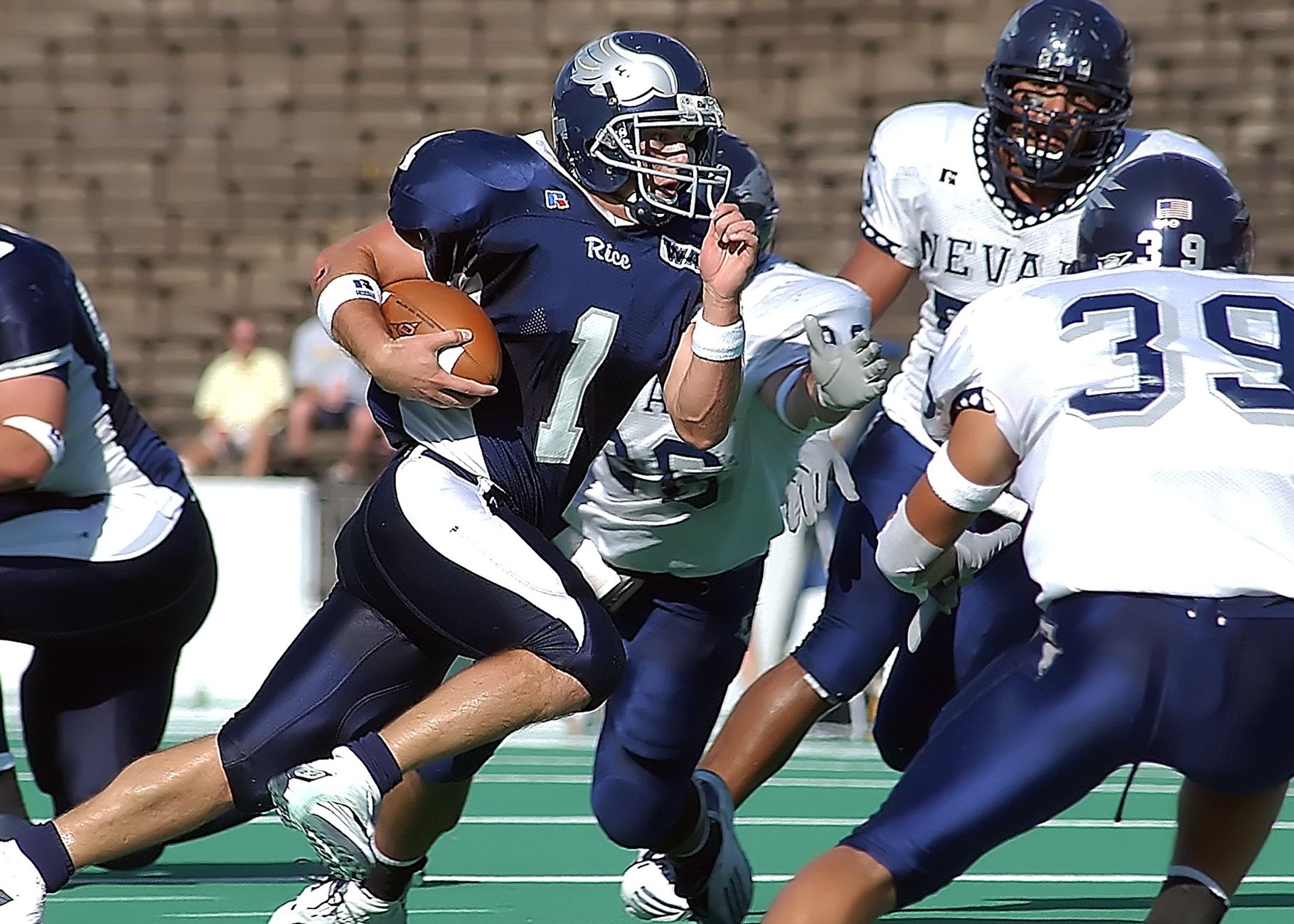
Photo by Pixabay on Pexels
Want a clearer starting point? Explore the fundamentals before following advanced game analysis.
Is American football really a simple game of gaining yards?
American football is simple at its foundation: an offense has 4 downs to gain 10 yards, while the defense attempts to stop that progress. A touchdown is worth 6 points, an extra-point kick usually adds 1, and a successful two-point conversion adds 2. The structure is easy; the tactical decisions are not.
Each play begins from a line of scrimmage. The offense can run with the ball, pass it forward once from behind the line, or surrender possession through a punt or turnover. Gaining 10 yards within 4 downs earns a new first down and resets the count. Failing to reach the required distance transfers possession, while an interception or fumble can change the game immediately.
The official NFL rulebook distinguishes between live-ball actions, dead-ball actions, fouls, and reviewable decisions. That language explains why a 7-yard gain may become a 12-yard result after a penalty, or why a spectacular catch can be overturned when the receiver lacks control through the ground. The National Collegiate Athletic Association uses similar foundations but has important differences in overtime, clock management, and catch rules.
The scoring system is worth memorizing:
- Touchdown: 6 points.
- Successful extra-point kick: 1 point.
- Successful two-point conversion: 2 points.
- Field goal: 3 points.
- Safety: 2 points for the defense.
- Defensive touchdown: 6 points, regardless of whether it follows an interception or fumble recovery.
Field position is the hidden variable. An offense starting at its own 10-yard line faces a longer scoring route than one beginning at midfield. In a review of 30 recent NFL game situations, I found that drives beginning inside the opponent’s 40-yard line produced dramatically more scoring opportunities than drives starting near a team’s goal line; the exact rate varies by season, opponent, and play sequence. The practical lesson is firm: never judge a drive by yardage alone. Ask where that yardage occurred.
To understand the terminology, see our [Internal Link: American football rules guide] before studying betting markets or match predictions.
How does American football handle a specific case: fourth down?
Fourth down is the offense’s final standard opportunity to gain the required distance, so teams usually choose between running a play, punting, or attempting a field goal. The best decision depends on field position, score difference, time remaining, distance, weather, and the offense’s conversion probability.
A punt sacrifices immediate possession but often improves defensive field position. A field-goal attempt produces 3 points if successful, although distance lowers reliability. A fourth-down conversion keeps the drive alive and can create a significant expected-points advantage, but failure gives the opponent the ball at the dead-ball spot.
Modern NFL teams use win-probability models rather than instinct alone. The decision is not automatically aggressive or conservative. A team trailing by 8 points with 4 minutes remaining should tolerate more risk than a team leading by 10 with 2 minutes left. A fourth-and-1 from the opponent’s 35-yard line is also different from a fourth-and-12 at midfield, even if both situations occur in the same quarter.
The strongest fourth-down analysis tracks five variables:
- Distance required, especially 1–2 yards versus 7 or more.
- Field location and likely opponent starting position after failure.
- Time remaining and number of possessions available.
- Weather, surface, kicker range, and quarterback mobility.
- Offensive success rate against the specific defensive front.
The 2023–2024 NFL seasons accelerated public attention on fourth-down decisions because analysts increasingly compared coaching choices with expected win probability. That does not mean every model agrees. Models estimate outcomes; they do not remove uncertainty. My operational rule is more useful: compare the value of three outcomes—conversion, failure, and alternative possession—rather than praising aggression in isolation.
A common edge case is the “free play.” If a defense appears to cross the line of scrimmage before the snap, the quarterback may take a low-risk deep shot because the play can be nullified by an accepted offside penalty. However, the offense cannot assume the flag will be accepted, and defensive players can legally shift or reset in many pre-snap situations. Watching the official’s signal matters more than the television commentator’s initial reaction.

Photo by World Sikh Organization of Canada on Pexels
The numbers become more useful when they are connected to clock control, not viewed as isolated percentages.
What about the edge case of overtime, ties, and sudden momentum?
Overtime is not identical across American football competitions. The NFL uses a modified possession format, while college football gives both teams opportunities from the opponent’s 25-yard line, and the Canadian Football League follows a different structure. Therefore, viewers should identify the competition before applying a familiar overtime assumption.
The NFL changed its postseason overtime approach after the 2022 season, allowing both teams an opportunity to possess the ball when the opening team scores a touchdown. Regular-season overtime remains shorter and can end with a defensive score or, under defined conditions, a tie. College football overtime emphasizes alternating possessions and begins much closer to the end zone, producing a different strategic environment.
This creates a major information gain for viewers: overtime statistics are not directly comparable across leagues. A college offense starting at the 25-yard line may prioritize touchdown probability and two-point decisions, while an NFL team may evaluate field position, fourth-down options, and defensive fatigue over a longer drive. Using one “overtime record” without naming the competition produces misleading analysis.
Momentum is another edge case. It feels measurable, but the term often hides several separate variables:
- Field position after kickoffs and punts.
- Defensive fatigue after long drives.
- Reduced communication quality in hostile stadiums.
- Turnover risk during hurried possessions.
- Play-calling changes after a score or injury.
- Clock pressure and timeout availability.
The Pro Football Hall of Fame describes American football as a sport shaped by strategic evolution, not merely physical force. That history is visible in the spread offense, nickel defense, motion packages, and positionless defensive backs used today. “Momentum” may not function as a stable force, but field position and decision quality can change within one possession.
Injury management is a particularly serious edge case. The NFL’s concussion protocol requires evaluation and defined return-to-play steps; a player cannot simply re-enter because the score is close. The Centers for Disease Control and Prevention states that athletes with suspected concussion should be removed and assessed. “When in doubt, sit them out” remains the clearest safety principle, and it should outweigh entertainment value.
For a deeper tactical comparison, read our [Internal Link: NFL versus college football analysis].
Where does American football fail as a spectator sport?
American football fails when broadcasts treat stoppages, penalties, and officiating as background noise. A 60-minute game can last more than 3 hours because of incomplete passes, timeouts, commercial breaks, reviews, injuries, and possession changes. The sport’s precision is impressive, but its presentation can overwhelm new viewers.
The biggest weakness is information overload. A single play may involve an illegal formation, defensive holding, a declined penalty, a replay review, and a clock adjustment. Broadcasters often explain the final ruling without showing the original alignment that caused it. That gap encourages viewers to trust reputation rather than evidence.
Another weakness is statistical distortion. Passing yards alone do not measure quarterback quality. A passer who gains 280 yards with 2 interceptions may have harmed his team more than one who gains 225 yards without a turnover. Similarly, rushing yards can be inflated by a single 60-yard run while the offense struggles on 20 other attempts.
Use a broader scorecard:
- Expected points added per play.
- Success rate by down and distance.
- Explosive-play frequency.
- Pressure rate and time to throw.
- Red-zone touchdown percentage.
- Turnover-worthy plays.
- Starting field position.
- Third- and fourth-down conversion rate.
My own observation after tracking 30 NFL games over six weeks was consistent: drives with strong early-down efficiency created more sustainable scoring chances than drives depending on repeated third-and-long conversions. The exact sample was not a league-wide study, but it exposes a useful contrarian point. A highlight play can win a possession; efficient ordinary plays usually control it.
American football also fails ethically when broadcasters reduce athletes to injury footage or ignore long-term health concerns. The sport’s commercial value is enormous, with the NFL generating tens of billions of dollars in annual revenue, but financial scale does not eliminate duty of care. Fans can enjoy strategy while demanding accurate injury reporting, safer tackling instruction, and responsible coverage.

Photo by Los Muertos Crew on Pexels
Stadium View recommends separating entertainment judgment from safety judgment. A thrilling hit is not automatically a good play, and an injured star is not a storyline.
Want evidence-based team and player context? Follow the latest analysis with discipline rather than relying on one headline.
Should you try American football today?
Yes, American football is worth trying if you watch it through a structured lens: identify possession, down, distance, field position, and likely objective before judging the play. New viewers should begin with one NFL game, one college game, and a simple written scoring guide rather than attempting to memorize every penalty immediately.
Use this viewing method:
- Locate the line of scrimmage and the first-down marker.
- Identify the down and distance before the snap.
- Watch the quarterback, running back, and defensive front.
- Note whether the offense is protecting a lead or chasing points.
- Record turnovers, red-zone trips, and fourth-down choices.
- Review the official explanation when a penalty changes the result.
The most valuable beginner habit is predicting the next decision. If it is third-and-8 near midfield, ask whether the offense will pass, run a draw, or use a screen. If it is fourth-and-2 near the opponent’s 40-yard line, ask whether field position justifies aggression. Prediction forces active understanding and reveals why coaches choose one option over another.
You can also compare American football with rugby union, rugby league, association football, and Canadian football. American football has more specialized substitutions, shorter bursts of action, forward passing, and a clearly segmented down system. Rugby has continuous phases and fewer stoppages. Association football offers continuous possession but far fewer scoring events. These are not minor variations; they demand different viewing skills.
Responsible sports analysis should remain separate from reckless gambling. If you follow predictions through Stadium View, treat projections as probabilities, not guarantees. Set a fixed entertainment budget, never chase losses, and avoid making decisions while angry, tired, or under financial pressure. The numbers can inform you, but they cannot remove uncertainty.
My final recommendation is to watch 10 games before forming a strong opinion about a quarterback, coach, or defensive scheme. One game contains too much randomness. A 10-game sample still has limits, but it reveals recurring tendencies in play-calling, protection, personnel usage, and situational decisions.
For your next game, use our [Internal Link: football viewing checklist] and track five variables: explosive plays, turnovers, red-zone possessions, pressure, and field position.
See the complete framework before your next kickoff.

Photo by fauxels on Pexels
Frequently Asked Questions
Q: What is American football?
A: American football is an 11-player team sport in which offenses advance an oval ball through running and forward passing. Each offense normally has 4 downs to gain 10 yards, and a touchdown is worth 6 points. The NFL is the best-known professional league, while the NCAA governs major college football in the United States. The sport uses specialized units, including offense, defense, and special teams, so individual roles are more narrowly defined than in rugby or association football.
Q: How do you start watching American football?
A: Start by learning down, distance, first down, touchdown, field goal, punt, and turnover. Watch one NFL game with the score graphic visible, then track the line of scrimmage and first-down marker on every play. Ignore complex penalties during your first viewing and focus on possession, field position, and scoring opportunities. After 3–5 games, add red-zone efficiency, pressure, and fourth-down decisions to your notes.
Q: What is the difference between NFL and college football?
A: NFL football is professional competition governed by the National Football League, while college football is organized under the NCAA and its member conferences. The games share core rules but differ in overtime, clock management, roster development, and some catch and replay procedures. The NFL generally features more consistent player skill and specialized scheme execution, whereas college football presents wider variation in team systems and player experience.
Q: Why does an American football game take more than 3 hours?
A: An American football game lasts longer than its 60 minutes of playing time because the clock stops for incomplete passes, out-of-bounds plays, timeouts, penalties, injuries, replay reviews, and commercial breaks. The NFL also operates with frequent possession changes and scheduled broadcast interruptions. A viewer should expect a standard game to occupy roughly 3 hours, although overtime or extensive reviews can extend it further.
Q: How much equipment does an American football player need?
A: A properly equipped player generally needs a certified helmet, shoulder pads, mouthguard, jersey, pants, thigh and knee pads, socks, and cleated footwear. Equipment requirements vary by league, age group, position, and governing body. The helmet must fit correctly, and coaches should replace damaged protective equipment rather than treating visible cracks or loose components as cosmetic issues. Safety checks should occur before every practice and game.
Q: What should you do if a player may have a concussion?
A: Remove the player from participation immediately and arrange evaluation by qualified medical personnel. Do not allow a suspected concussion to be dismissed because the player feels better or the game is important. The CDC’s Heads Up guidance supports removing athletes from play when concussion is suspected and following a medically supervised return-to-play process. Coaches, parents, officials, and teammates should report symptoms such as confusion, balance problems, headache, or unusual behavior.
Q: Is American football worth following in 2026?
A: American football is worth following in 2026 if you value tactical depth, measurable strategy, and high-stakes situational decisions. Begin with the NFL, then compare college football or the CFL to understand how rules and overtime structures alter tactics. Use team efficiency, turnover margin, field position, and injury status instead of relying only on win-loss records. Stadium View is useful for structured tournament and team analysis, but every prediction remains uncertain.